

Nobody tells you the truth about hand creams, they tell you the highlight reel. I run the pastry station at a restaurant kitchen, which means my hands spend ten hours a day cycling between ice water for buttercream, hot dishwater, and enough flour to coat a countertop twice over. I picked up a jar of O'Keeffe's Working Hands three winters ago because a line cook I worked under practically shoved it into my apron pocket and told me to stop complaining. I almost put it back on the shelf the first night because of the smell, and if you've read a glowing five-star review that skipped that part, it wasn't written by someone who actually opened the jar cold.
This isn't a six-month diary or a before-and-after glow-up story. This is the version where I tell you what surprised me, what annoyed me, and where I think other reviews are quietly leaving things out, either because they didn't use it long enough to notice or because they didn't want to say anything that might talk you out of buying it. Some of it is genuinely great. Some of it needs a warning label.
The Quick Verdict
A serious, effective hand cream for real cracking and damage, but it's thicker, slower to absorb, and stronger-smelling than most people expect walking in. Worth it if you know that going in.
Amazon Check Today's Price →Tired of hand creams that feel nice for ten minutes and do nothing by hour three?
O'Keeffe's Working Hands isn't a light lotion, it's built for skin that's already cracking from repeated washing, cold, or dry heat. Check today's price on Amazon and see if the tradeoffs below are worth it for your hands.
Amazon Check Today's Price on Amazon →How I Actually Tested This
I didn't do a clean, controlled trial. Kitchen life doesn't work that way. What I did was apply it after every shift, right before I left the building, for a full winter, then again the following two winters because the first one convinced me. I kept the jar in my locker, not at home, because if it wasn't sitting right next to my keys I knew I'd skip it half the time.
I also did something I don't see in most reviews, I used it on only one hand for the first ten days, my left, and left my right hand doing whatever it normally does, which at the time was nothing beyond an occasional squirt of the lotion pump by our handwashing sink. That's not lab-grade science, but working a knife station means your two hands do genuinely similar work, so the comparison meant something to me. By day ten the difference in how my knuckles looked under the kitchen lights was obvious enough that I stopped the experiment and started using it on both hands, because it felt unfair to my right hand at that point.
I didn't change anything else about my routine during that first winter. Same industrial dish soap, same handwashing frequency our health code requires, same lack of gloves during hot prep work because gloves make certain plating tasks nearly impossible. That matters because a working kitchen is already an aggressive environment for skin, hot water, degreasing soap, and constant contact with acidic ingredients like citrus and vinegar. If something worked under those conditions, I figured it would hold up fine under milder, everyday conditions too.
I want to be clear that my hands weren't in crisis before this. They got dry, tight, and occasionally split at the first knuckle during the coldest stretch of the year, the kind of cracking that stings when you're seasoning something with salt on your fingertips. That's a different starting point than someone with severe eczema or a dermatologist-diagnosed condition, and I think that distinction matters more than most reviews admit.
The Greasy Feel Nobody Warns You About
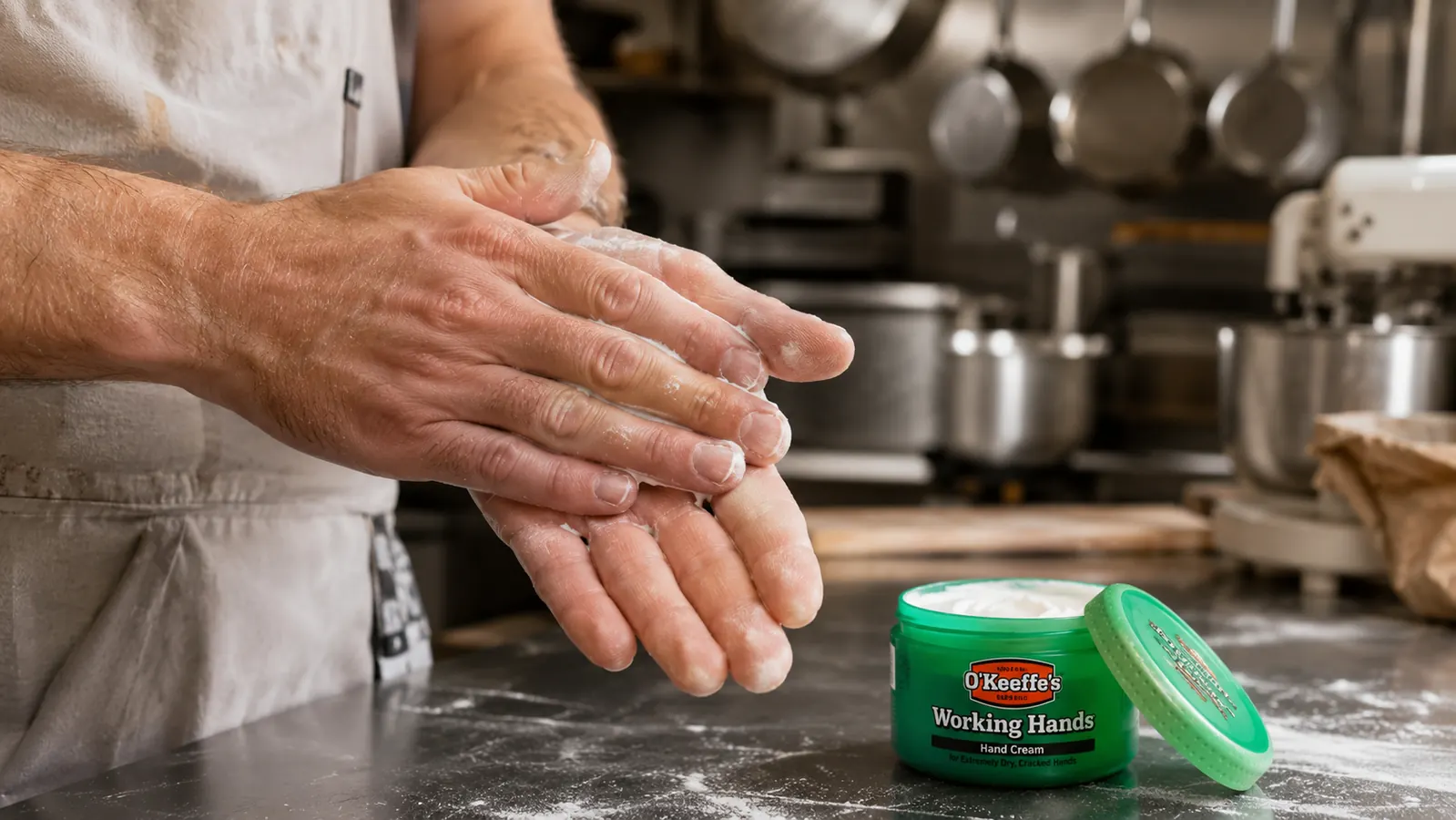
Here's the part I think gets glossed over. This cream is thick. Not lotion-thick, more like a dense salve that sits heavy in your palm right out of the jar. The first thirty seconds after applying it, your hands genuinely feel greasy, slick enough that I wouldn't want to grab a knife handle or a piping bag right away. I learned to apply it as the very last thing before I clock out, never mid-shift, because there's no version of cooking or plating food with this on your hands that works cleanly.
It does absorb, that part is true, but it takes real time, closer to a full minute of active rubbing than the ten seconds a typical lotion needs. If you're expecting something you can smear on and immediately go back to typing, folding laundry, or handling paper, you're going to be annoyed the first few times. Once I built it into my end-of-shift routine instead of trying to squeeze it into a break, it stopped being a problem, but that adjustment is real and worth knowing about before you buy it, not after.
The smell is the other honest sticking point. It's not perfumed, there's no floral or citrus cover scent, it smells like the base ingredients themselves, which reads as slightly medicinal, almost like a first-aid cream. In an open kitchen with food smells everywhere it faded into the background fast, but I noticed it more the first winter I used it at home in a quiet apartment. If you're sensitive to smell or you're applying it right before you're around other people in a small space, give it a minute to settle before you're in close quarters.
One thing I've never seen mentioned anywhere is what happens if you apply it and then need to handle anything porous right away, wood cutting boards, paper menus, a cloth napkin. It will leave a faint mark until it's fully absorbed. I ruined the corner of a recipe notebook the first month before I figured out the timing. Small thing, but it's exactly the kind of detail that only shows up after real, repeated use, not a two-week sample.
What's Actually Different About the Formula
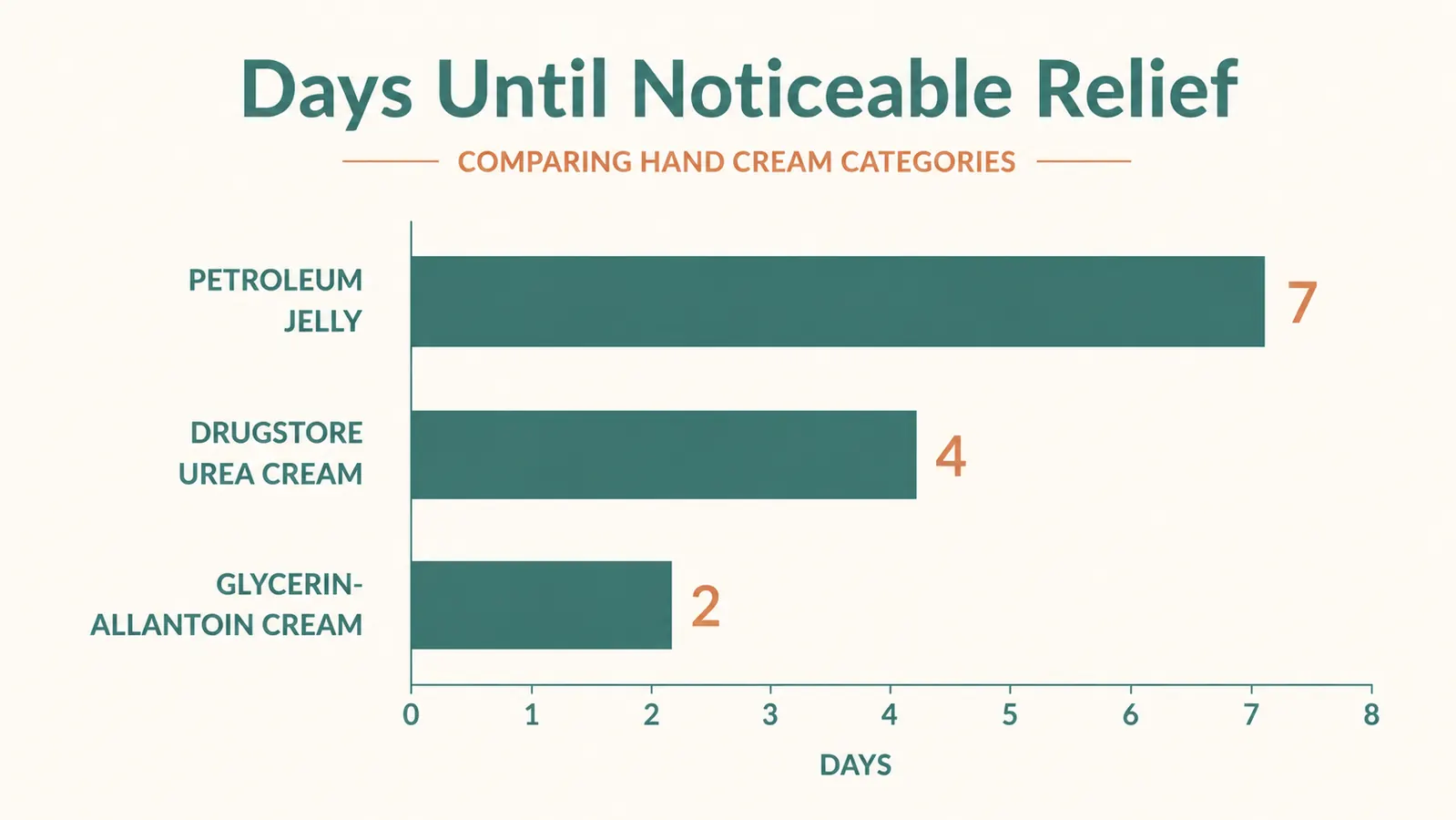
The ingredient that separates this from a plain petroleum-jelly-based product is allantoin, paired with a concentrated glycerin base. Glycerin draws moisture into the skin rather than just sealing whatever is already there, and allantoin is a compound that shows up a lot in products meant for genuinely damaged, cracked, or irritated skin because it softens and smooths tissue instead of just blocking air and water on the surface.
That's the reason plain Vaseline never fully solved my cracking, even though I used a tub of it for a full winter before switching. Vaseline sits on top and traps moisture, which helps mild dryness, but it doesn't do much for a knuckle that's already split open because there's nothing in the formula actively working on the damaged skin itself, it's just a barrier. I also tried a drugstore urea cream one year on a coworker's recommendation, and while urea creams are genuinely good for rough, thickened skin like heels, I found it stung noticeably on the open cracks at my knuckles in a way this cream never did.
I'll also say the texture stays consistent from the top of the jar to the bottom, which sounds like a small thing until you've used a cream that separates or thins out toward the last quarter. Mine never did that across three winters of use, and the last scoop worked exactly like the first.
The Two-Week Wall
This is the part I think causes most people to quit and leave a mediocre review before it's really had a chance. The first week and a half, I honestly didn't notice a dramatic difference. My hands felt less tight by the end of a shift, sure, but the actual cracked skin at my knuckles was still there, still catching on dish towels, still stinging under running water. If I'd stopped at day ten, I probably would have written this up as fine, not great.
Somewhere around day twelve to fourteen, the cracks that had been open for weeks actually started closing rather than just feeling softer. That's a specific, noticeable shift, not a gradual fade. It lines up with what I'd expect from an ingredient that's working on repair rather than just surface hydration, repair takes longer to show than a temporary moisture boost does. If you're the type of person who judges a product after three or four uses, this one is going to disappoint you regardless of whether it would have worked, because it just needs more runway than that.
Past that wall, the maintenance was easy. Once my knuckles had actually closed, a single nightly application kept them that way through the rest of the winter, even with the same hot water and dish soap exposure that caused the problem in the first place. The hard part was never the daily habit, it was getting through those first ten to fourteen days without giving up on it.
Does It Work Anywhere Besides Your Hands
This question comes up a lot, so I'll answer it honestly since I've actually tried it. I used a small amount on my cracked heels one winter after running out of my usual foot cream, and it worked, though it took a bit longer than on hands, probably because heel skin is thicker and callused. I also tried it on a rough patch on my elbow that gets dry from leaning on the prep counter all day, and that cleared up within a couple of weeks the same way my knuckles did.
Where I would not use it is anywhere near my face. The texture and scent are both built for tough, thick skin on hands and feet, and it feels far too heavy and greasy for facial skin, even the rough patches some of us get on our cheeks in winter. If you're looking for something for your face, this isn't it, and I don't think the label ever claims otherwise, it's just a question I get asked often enough that I wanted to address it directly.

Where This Falls Short
It won't touch a diagnosed skin condition. I have a coworker with dermatologist-confirmed eczema on her forearms who tried this after hearing me talk it up, and it did essentially nothing for her flare-ups, because this is a heavy-duty moisturizer and crack-repair cream, not a medicated treatment. If you've been told by a doctor that you have eczema, psoriasis, or dermatitis, this belongs alongside your actual treatment, not instead of it.
The jar is also a genuinely bad travel format. I ended up scooping a small amount into a metal tin I keep in my kitchen bag, because carrying the full jar to and from work every day wasn't realistic and it's not something that fits neatly in a coat pocket or a small bag. Minor complaint, but if you're planning to use this away from home regularly, plan for the repackaging step, the product itself doesn't come set up for it.
It also costs more per ounce than a basic drugstore lotion, and I think that's worth saying plainly rather than dancing around it. If your hands are only mildly dry, you're paying a premium for repair power you don't actually need, and a cheaper everyday lotion will serve you better. This only earns its cost if your skin is genuinely cracked and other things haven't worked.
What I Liked
- Genuinely closes cracked, split skin rather than just softening the surface
- Glycerin and allantoin formula outperformed plain Vaseline on knuckles that were already split
- Held up through a full winter of hot dishwater and constant handwashing
- Once cracks closed, a single nightly application was enough to maintain it
- No sting on open, cracked skin, unlike the urea cream I tried
- Also worked on cracked heels and a dry elbow patch, not just hands
- Consistent texture from the first scoop to the last
Where It Falls Short
- Genuinely greasy for the first thirty to sixty seconds after applying, not suitable for mid-task use
- Distinct medicinal smell that some people will not enjoy, especially in small spaces
- Takes ten to fourteen days before you see real closing of cracks, which loses impatient users
- Jar format is awkward to carry, worth transferring to a small tin
- Costs more per ounce than a basic drugstore lotion
- Does nothing for diagnosed conditions like eczema or psoriasis
- Too heavy and greasy to use anywhere on the face
If you stop at day ten because nothing seems to be happening, you're quitting right before the part where it actually works.
Who This Is For
This makes the most sense for anyone whose hands are in water, cold, or friction for hours at a stretch and are already showing real cracking, not just tightness. Kitchen and food service workers, healthcare workers who wash and sanitize constantly, anyone doing outdoor or manual labor through a cold season, and anyone who's tried a lighter lotion and watched it do nothing for skin that's actually split open. If your hands look and feel like mine did that first November, this is worth the two-week patience it asks for.
Who Should Skip It
If your hands are dry but not cracked, this is heavier and greasier than you need for daily maintenance, a lighter lotion will feel better and do the job. If you're someone who needs to go straight from applying hand cream into detail work, typing, or handling paper, the absorption time will frustrate you unless you build in a buffer. And if you're managing a diagnosed skin condition, talk to your dermatologist about where this fits rather than expecting it to replace prescribed treatment.
Three winters in, and I still keep a tin of this in my kitchen bag.
It's not a light everyday lotion, and it asks for a little patience before it shows what it can do. If your hands are cracking, not just dry, O'Keeffe's Working Hands is worth the two-week test. Check today's price on Amazon and see for yourself.
Amazon Check Today's Price on Amazon →